


INTESTINAL HEALTH
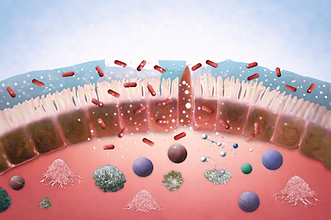
The intestinal epithelial barrier plays a vital role in maintaining health by regulating the selective passage of nutrients while preventing the entry of pathogens and harmful substances. Disruption of this barrier, often referred to as “leaky gut”, can result in low-grade chronic inflammation.
This dysfunction is implicated in a range of gastrointestinal and systemic disorders.


Intestinal
Health


PERMEABILITY
A leaking gut barrier facilitates translocation of harmful substances and the development of inflammation.

The Assay
-
This assay evaluates the ability of a test compound to maintain or restore intestinal barrier integrity.
-
Differentiated intestinal epithelial monolayers are exposed to dextran sulfate sodium (DSS) or a cytokine cocktail to induce inflammation and disrupt barrier function.
-
The protective effect of the test product is quantified by measuring Lucifer Yellow (LY) permeability and/or by analyzing the expression of tight junction markers.
-
The test compound can be applied before, during, or after induction of inflammation, depending on intended readout.


Incubation with the product
Simulation of inflammation
(DSS or cytokines)
qRT-PCR
for specific markers
Incubation with LY
Intestinal cells
Bioinformatic
& customized visualization
Measure
Basolateral LY

WOUND HEALING
The intestinal epithelium renews itself every 3–5 days, requiring precise regulation of cell proliferation, differentiation, and wound healing to maintain tissue integrity.

Bioinformatic
& customized visualization
Cell differentiation in insert
Removing insert
Incubation with test product
Time to close the gap
qRT-PCR of markers
The Assay
-
This assay evaluates the ability of products to promote epithelial repair.
-
Intestinal epithelial cells are cultured and differentiated using the ibidi Culture-Insert 2-Well system, which creates a standardized, cell-free “wound” area. Following barrier removal, gap closure is monitored microscopically over time, providing a quantitative measure of cell migration and regeneration. Optionally, the expression of repair and proliferation markers can be analyzed by qRT-PCR.


MUCUS PRODUCTION
-
The mucus forms a protective barrier that shields the intestinal lining from pathogens, toxins, and mechanical damage while maintaining a stable environment for beneficial microbes. It also supports healthy immune responses and ensures smooth nutrient absorption by preventing inflammation and preserving epithelial integrity.
The Assay
-
The mucus production assay is designed to evaluate a compound’s ability to stimulate mucin production and secretion by epithelial cells.
-
In this assay, intestinal epithelial cells are cultured and treated with the test product. After incubation, mucus production can be quantified using specific staining methods, such as Alcian Blue or Periodic Acid–Schiff staining, mucin-specific ELISAs, or qRT-PCR analysis of mucin-related gene expression

Quantification transcription (MUC2, MUC5AC, MUC1, MUC4)
Add Test Product
Cell growth and differentiation
in semi-liquid conditions
Bioinformatic
& customized visualization
Quantification secretion (MUC2, MUC3, MUC4, MUC5AC)
ANTI OXIDATIVE STRESS
-
Oxidative stress, which occurs when reactive oxygen species overwhelm the body’s antioxidant defenses due to factors like inflammation, infection, poor diet, pollutants, or cellular metabolism, can damage intestinal cells, weaken the gut barrier, and trigger inflammation.


Add an oxidative stressor
Cell growth and differentiation
Incubate with product
Measure ROS
The Assay
This assay evaluates the ability of a test compound to protect epithelial cells against oxidative stress.
-
Epithelial cells are pre-incubated with the test product, then exposed to an oxidative stressor (e.g., H₂O₂ or AAPH) in the presence of a fluorescent probe (e.g., DCFH-DA).7
-
The probe reacts with reactive oxygen species (ROS) to generate a measurable fluorescent signal, reflecting intracellular oxidative activity.


MICOBIOME MODULATION
-
The gut microbiome plays a central role in health by regulating key physiological processes within the intestine and far beyond. Through its effects on epithelial barrier function, immune signaling, and the production of bioactive metabolites, the microbiome can influence a wide range of physiological functions involved in intestinal health.
-
Especially, the health of enterocytes, the intestinal barrier integrity, the inflammatory environment etc.. As a result, modulation of the gut microbiome represents an important strategy to support intestinal health.
-
With VETPLATE, we offer a comprehensive and integrated approach to analyse your product’s effects on the microbiome and its resulting impact on intestinal health and related physiological functions.
-
In addition to analyzing the impact of your product on microbiome composition, supernatants from microbiome cultures can be further tested for their metabolite profile and their effects on the intestinal healh.

