


Gut-Brain Axis
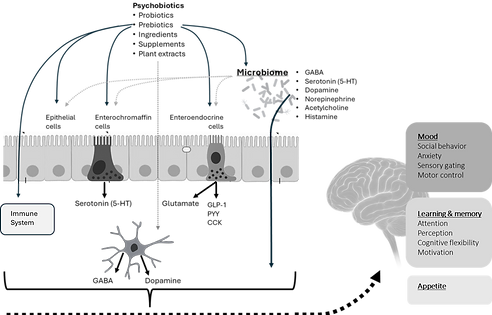
The Gut–Brain Axis integrates neural, immune, endocrine, and metabolic signaling pathways to regulate mood, cognition, and behavior.
Probiotics, prebiotics, nutritional ingredients, plant extracts, and dietary supplements may have psychobiotic properties, thereby modulating this axis.

We established several assays to provide insights into the effect of your products on Gut-Brain Axis
Our Experts are here to help you uncover the full potential of your products.
Products may impact fundamental neurophysiological and behavioral processes, through:
1
2
3
4
Stimulating enterocytes, enterochromaffin (EC), and enteroendocrine (EEC) cells to secrete neurotransmitters and signaling peptides.
Activating enteric neurons (ENS), leading to local neurotransmitter release and transmission of signals via the Vagus nerve to the brain.
Modulating the gut microbiome, enhancing its ability to produce neuroactive metabolites and/or further stimulate epithelial and neuronal communication.
Modulating the immune system by decreasing pro-inflammatory signaling and promoting an anti-inflammatory cytokine profile.
1
1
1
4
3
2
ENTEROCHROMAFFIN CELLS
Enterochromaffin (EC) cells are key sensory cells in the gut that detect mechanical and chemical stimuli and convert them into biological signals. They release serotonin (5-HT), which activates enteric neurons and vagal afferents, forming a major communication pathway in the gut–brain axis. Through this signaling, EC cells influence gut motility, mood, appetite regulation, and systemic physiological responses.

RIN-14B
Differentiation
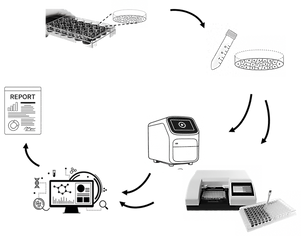
Incubation with product
Quantification of transcription
Bioinformatic & customized visualization
Quantification:
-5-HTP
Serotonin (5-HT)

THE ASSAY
-
The RIN-14B cell line is derived from rat intestinal neuroendocrine (enterochromaffin-like) and serves as a valuable in vitro model for studying the Gut–Brain Axis, particularly in assessing how products influence enteroendocrine signaling and serotonin-mediated communication between the gut and the nervous system.
-
In our assay, the differentiated RIN-14B cell line is used to evaluate the impact of the test compound(s) on neurochemical signaling, especially the modulation of serotonin production.
ENTERIC NEURONS
Enteric neurons form an extensive neural network within the gastrointestinal tract and serve as a major communication hub in the gut–brain axis. They detect and integrate signals from gut contents, microbiota metabolites, and enteroendocrine cells, then relay this information to the central nervous system via the vagus nerve and spinal pathways. Through this bidirectional signaling, enteric neurons regulate gut motility, secretion, immune responses, and contribute to emotional and cognitive processes influenced by the brain.

Caco2 cells
Differentiation
SH-SYS5

Monoculture
Co-Culture
Incubation with
pnoduct
Test available for
•Physiological condition
•Pre-treated with glutamate
•Oxidative stress
Bioinformatic & customized visualization
Quantification:
•Cell death (pro-apoptotic markers)
•Cytokine production (TNF-α, IL-1β, IL6)
•Production of GABA, Dopamine
Differentiation
THE ASSAY
-
The SH-SY5Y cell line is a human neuroblastoma-derived model that is widely used to investigate how compounds influence neuronal viability, neurotransmitter signaling, and neuroinflammatory responses.
-
In our assays, the differentiated SH-SY5Y cell line is used to evaluate the impact of the test compound(s) on cell viability and neurochemical signaling, including the modulation of pro-apoptotic markers, cytokines, and key neurotransmitters such as GABA and dopamine.
-
The assay can be performed using SH-SY5Y monocultures or co-culture systems. Optionally, cells can be pre-treated with glutamate to simulate depression- or mood disorder–like conditions.
COMBINED ANALYSES FOR GUT-BRAIN AXIS
The effect of a product on the gut–brain axis can be evaluated through combined analysis of the microbiome and the host.
These analyses provide an integrated view of how the product modulates gut microbial activity and how these changes translate into host responses along the gut–brain axis.
On the microbiome side:
The assessment focuses on changes in microbial composition and metabolites, including:
shifts in short-chain-fatty-acid-producing genera,
shifts in pro-inflammatory or mucosal-protective genera,
shifts in bacteria involved in tryptophan metabolism.
shifts in microbial metabolites such as SCFAs and microbiota-derived neurotransmitters

On the host side:
The analyses focuses on the effect of these microbial signals on key physiological pathways, including:
neurotransmitter production,
inflammatory responses
intestinal barrier integrity.

&

Microbiome composition
•Genera producing SCFA
•Pro-inflammatory genera
•Mucosal protecting genera
•Tryptophan metabolizing genera
•etc.
Microbiome metabolites
•SCFA
•Neurotransmitters etc.
Microbiome functions
Neurotransmitters
Inflammation
Barrier Integrity
Enterochromaffin
cells
Enteroendocrine
cells
Immune
cells
Enteric
Neurons
Effect on Host
Effect on Microbiome
Have a non-binding consultation with one of our experts to find out the best solution for your needs.

